October 22, 2026
The Ultimate Google Ads Playbook for Garage Door Companies
A dad’s about to leave for work and notices his garage door didn’t close from the night before. It’s 7:30 in the morning, and he doesn’t want his kids coming home with the door still open. It’s a safety risk.
So he goes straight to his phone and Googles “garage door repair near me”. He looks for a company that’s nearby AND has great reviews. He calls the first one he thinks can get the job done, and no one picks up. Here’s the part I’d want you to sit with: fewer than half of the calls to home service companies ever get answered by a person. Fewer than half. So every morning, half the garage door emergencies in your town go to whoever picks up first. So he calls another company. This time it’s your company, and you pick up the phone immediately. You schedule a time to meet that day, you fix his garage door, and he can sleep well that night. They’ll tell all their neighbors about you.
The best home service leads come from Google. With Google Ads, garage door companies can get in front of customers when it’s an emergency and land that customer fast. While with SEO, the same spot could take months, and I’ve covered that process in my guide to garage door SEO.
By the end of this blog post, you’ll learn how to verify your business in Google (they just changed the rules again!), how to build campaigns so you can balance someone who needs a spring replaced versus someone who might lead to a $3,000 new garage door, how to avoid people who are just doing research, and the number one thing you want to measure to know if your campaign is working.
TL;DR
Google requires garage door service companies to verify their business before they can even start running search ads or Local Service Ads. It takes from 5 – 30 days to get verified. Once you’re all set up, you’ll want to split your campaigns by type of service, block people looking to do it themselves, set up your pages so people can call you quickly, and above everything else, track your leads!

1. Get through verification first
Google requires you to verify your business in both Google Ads and Local Services Ads before they’ll serve your ads. Unfortunately, lead resellers and fly by night companies abused Google Ads, so Google had to do this. I know. It’s annoying. But once you’re verified, you’ll stand out and won’t have to worry about showing up next to some guy who just started his business.
Verification typically takes around 5 days to a month.
So if you were planning a spring campaign for March, you’ll need to get started before March 1st.
Here are a few things that can cost you some time
All of this comes from Google’s own guidance, and I’ve watched every one of them slow somebody down:
- Build a campaign before you apply. Go ahead and create a campaign and leave it paused. This way, Google can see what you’re trying to target first.
- Watch your trigger words. Targeting “emergency” keywords or having “emergency garage repair” on your site can set off Google’s automated flags during review.
- Make sure your website is live when you apply, because Google’s review team will automatically scan your site to make sure it’s working.
- Clean up your pricing. Spell out any coupon, discount, or offer in your ads or on your site to spell out what it includes and excludes. For example, a $499 installation needs to mention what type of door and any limits right next to it.
- One business, one account. You’re limited to having only 1 business per account. If you have other businesses, create new accounts for them.
If you only take one thing from this post, start verification this week!
2. Why I start garage door companies on Local Services Ads
Local Services Ads (LSAs) show up on the top of Google. Above the search ads, above the map pack, above the organic listings. When it’s an emergency, people are going to click on the first listing they see.
There are two major differences from regular search ads.
With LSA ads, you pay per lead, not per click. A lead comes in the form of a call, a message, or a booking. If someone taps on your ad and leaves, it will cost you nothing. And you can dispute leads if it’s a sales call, a wrong number, or a job outside your area.
Second, the badge. Google’s Verified badge is worth more than it’s weight in gold. When a homeowner sees that badge, they’ll be confident they’re contacting a company that has been vetted.
Winning the LSA auction is an operations problem
You cannot simply outbid your way to the top of Local Services Ads the way you can with a search campaign.
Your bid matters. Don’t get me wrong. It just isn’t everything.
Here’s a list, lifted right from Google’s help documentation, of what actually determines order:
Local Services Ads are ranked by your bid and by how likely your ad is to result in a lead, as determined by: how responsive you are to customers (inquiries and requests), what a customer is searching for, how closely your business matches the customer’s search, whether message leads and booking leads are turned on, and your profile quality (rating, number of reviews, your average response time, high-quality images, and verified attributes that have been confirmed).
Okay, so read that list again. Four of the five things on that list will never be influenced by marketing. They’re strictly operations.
Which means you have to be on top of every lead and every job to beat your competitors.
Answer your phone immediately. Even Saturday. Not answering a call will tell Google you’re not super responsive, and how you show up will determine when Google shows your ad.
Ask your customers for a review after every job. Here’s the scary part: 47% of consumers won’t hire a local business with fewer than 20 reviews. And 74% say reviews must be recent (in the past three months). So 40 reviews from 2022 isn’t a review profile. It’s a museum. LSA pulls your reviews from your Google Business Profile. Take a look at your competitors. If they have WAY more reviews than you or a higher score than you, then start with getting your Google Business Profile in shape before you spend a dollar on LSAs.
Dispute junk leads weekly. Spend fifteen minutes every Monday reviewing your leads and dispute those sales calls or people who are 100 miles away.
Enable message and booking leads. Not many people know about this one, but it’s on Google’s ranking factors list. When customers have more ways to contact you, Google decides that your ad is more worthy of being shown. Just five minutes of your time in your LSA profile. Do it now.
LSAs vs. Google Ads

While Local Services Ads (LSAs) put you at the very top of Google and you only pay per lead, you have almost no control over which jobs you get. On the other hand, Google Ads gives you full control to target high-margin services. Want to win? Run both. That’s the setup I run for every garage door client I have. Use LSAs for emergency repairs, and Google Ads for those $3,000 new garage door installs.
3. Build your campaigns in lanes, not one bucket
Here is the one thing I see every garage door company owner do.
They build one campaign and put spring repair keywords right next to custom wood door keywords.
Door springs and garage door installation are two completely different businesses. Replacing a spring averages about $250 across the country. Installing a two-car garage door costs between $2,200 – $3,300. One installation nets you ten spring jobs.
When you bid the same on a $3,000 installation keyword and a $250 repair keyword, they compete for the same budget, and you’re telling Google you’re willing to pay the same for both.
Instead, split them up by service.
Giving each service its own campaign means separate budgets, bids, ad copy, and landing pages. Finally, you can answer the question: which type of work is my advertising actually bringing in?
Once you’re seeing a good amount of leads from the campaigns above, go ahead and create a campaign for opener repairs and replacement.
AI Max
Google just rolled out AI Max, which uses AI to find more opportunities for your Search ads to show up. Use extreme caution before turning this on. In my testing, it rapidly exhausted budget on completely irrelevant searches. You’ll find your ads displaying for very specific garage door manufacturers you likely don’t service. Think Amarr, Clopay, Wayne Dalton. You’ll also start paying for clicks from your local competitors simply because they have “garage door” or “garage door repair” in their business name. Because AI Max relies heavily on broad matching, you’ll constantly be triggered by pure researchers. So you’ll pay for searchers looking up DIY videos, installation tips, part numbers, etc.
One note on scheduling. If you do not provide 24/7 emergency services, do not run ads on repair terms after work hours. You’ll be paying a premium for calls to only go to voicemail, which might as well go to your competitors.
The opposite can happen too. A client called me recently saying they were slammed, but the calls all seemed to come in around 1 pm and right before closing. That was helpful, and I was able to spread their budget around so calls came in throughout the day instead.

4. Keywords that buy intent and negatives that stop the bleeding
I’ve watched a garage door company pay $18 a click for someone searching “garage door paint ideas.” That’s what broad match keywords do.
I always recommend using EXACT and PHRASE match keywords for your services. Don’t use garage doors. Get specific instead: [garage door spring repair], [garage door opener repair], “garage door off track”, [garage door replacement cost].
If you can’t invoice your customer for the keyword, do not bid on it.
If you’re not sure what match types are or how they work, I wrote a full breakdown of Google Ads match types.
Your negative keyword list is doing more work than your bids
I mean it. In your first ninety days, adding negative keywords will pull more weight than any bid adjustments you can make.
The average home improvement click costs $8.33. Google doesn’t care if that click came from a homeowner with a broken spring or a dude looking for repair manuals. The only thing protecting you from that click is your negative list.
So block them. Start here:
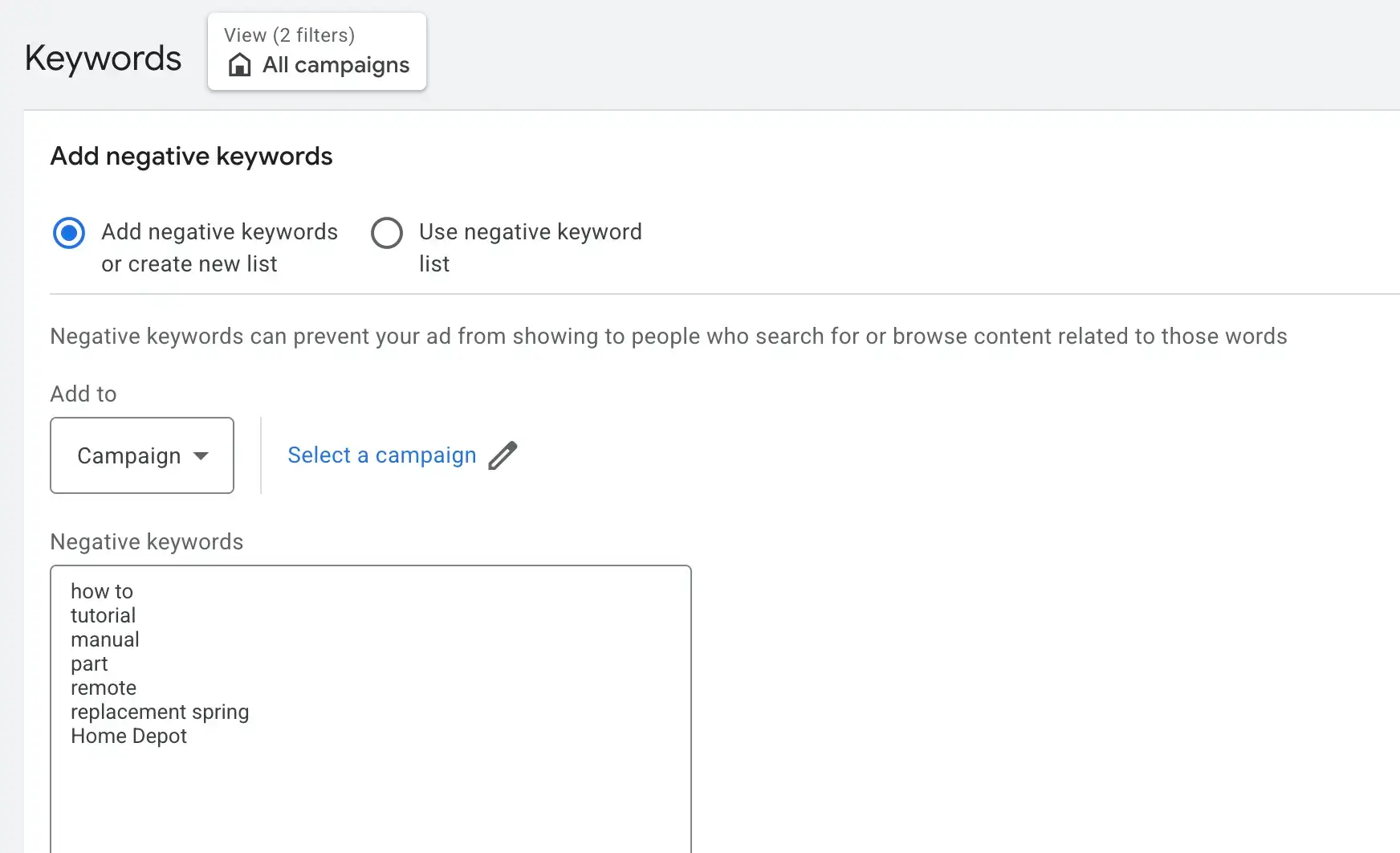
- DIY & Parts: how to, tutorial, manual, parts, remote, replacement spring, Home Depot
- Cheap & Unqualified: free, cheap, used, commercial (if you’re residential), RV, barn
- Job Seekers: hiring, salary, apprentice, license
That is a good start, but you’re not finished. To find more negative keywords, review your search terms report weekly. I go deeper on how to find them and start building your negative keyword list.
One thing to be careful with is “near me” and location keywords in your negative keywords. Oh, and be careful with the word emergency. Google normally flags it during its verification process. Instead, use “same day” and “24 hour” in your copy. Pulling the search terms report every week is the part nobody keeps up with. I don’t blame you, it’s tedious. If you’d rather it just got done without you thinking about it, that’s what you’re hiring a Google Ads consultant for.
5. Stop sending paid clicks to your homepage
You’ve probably seen those late-night commercials for the latest fitness machine that tells you’ll get 30% off if you go to NuMetalFlex.com/30 or whatever. That /30 is a landing page they’re sending you to so they know A where you came from and B so they can track which discounts are working.
If all your ads point to your homepage, you’re missing customers whose garage door just got stuck and who need to get to work.
That person. That customer needs you ASAP! Use a special landing page for your emergency cases.
Repair pages sell speed
Most people will be on their phone, standing in their garage, frantically searching for “garage door repair.” They don’t have time to wait. Make it easy for them to call you!
Here’s how:
- Have your phone number above the fold. Make it large, make it click-to-call, and add a phone icon next to it to make it really stand out.
- Add a giant click-to-call button for mobile visitors that follows them down the page as they scroll.
- Include your service in the headline. If they searched for broken spring, the first thing they see should say “Broken Spring? Call Us Today!”
- Add proof. Have your reviews, years in business, and photos of your work truck.
Installation pages sell trust and taste
A person looking for a new garage door is a completely different customer. They have been thinking about their dream garage door for awhile; they are going to talk it over with their spouse, and they are comparing you to two other garage door companies.
- Before and after photos. Include jobs you’ve actually done. Ideally, only of the type of houses in your market.
- Give pricing. You don’t have to have an exact number. A range will work.
- Financing, if available. Some customers would rather pay over time. Give them the option.
- A short quote form. Only request their name, phone, zip, and photo. Your customer doesn’t have all day to fill out contact forms.
- Warranty terms in plain English. Google requires your warranty info for LSA ads.
Remember to build one landing page per service. I use the same practice for my SEO for garage door companies, because optimizing their site for organic search along with Ads helps them get the most coverage on Google.
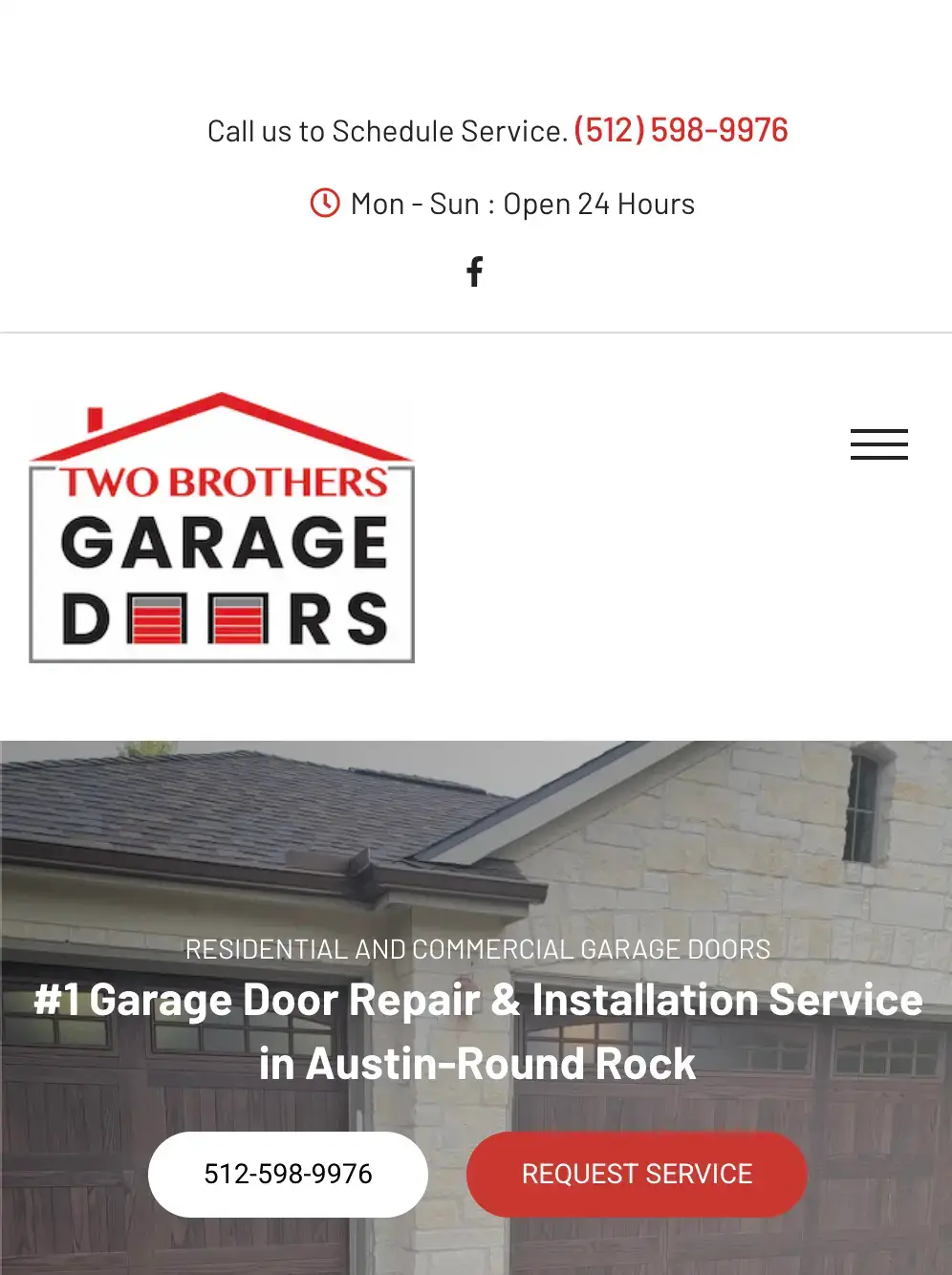
Check out how I helped an Austin garage door client, Two Brothers Garage Doors, with SEO in this case study.
6. What to spend and the only number worth reporting

After we talk strategy and all the nitty-gritty stuff clients always want to know: what do I need to spend?
I tell them it depends on their market size and how competitive it is in their city. But I would say for an average garage door company in a decent sized metro in Texas, I’d recommend $1,500 to $3,500 a month to start.
I’m not just pulling that number out of my rear end. Let me show you why.
The average click in home improvement is $8.33. With a conversion rate of roughly 8%, you need approximately 124 clicks per month to get the ten leads per month Google thinks you’ll need before its algorithm starts acting smart. Multiply those clicks times your CPC and you’re looking at $1,035.
Want 1 lead/day? 373 clicks a month. $3,100 a month.
That’s your range right there. And remember, that’s at category averages. Before garage door repair keywords jack themselves up like they will in a competitive metro.
Run it backward as well. At $8.33 per click, you can buy 60 clicks per month with a $500 budget. 60 clicks equals 5 leads a month at 8%. Five leads a month isn’t a campaign. It’s flipping a coin and paying $500 for heads.
If a tight budget, only run repair ads and add a campaign for installation once the repair campaign pays for itself. I broke down what Google Ads actually costs across home services in a separate post.
Cost per click is a vanity metric
A lot of people want the lowest cost per click. But that’s backward.
The national average cost per lead for home improvement is approximately $91. If you’re below that and your leads are converting (booking), stop worrying about your CPC.
Instead, I focus on cost per booked job.
Yeah, that’s right. Cost per booked job. Not cost per lead, because not all leads will close.
Track repairs and garage door installations separately. If you’re spending $95 per job booked on a $250 repair you’re winning and should be spending more. If you’re spending $600 per job booked on a $3,000 door at 40% margin, you’re making $1,200 gross profit on a $600 lead cost. You’re killing it. You’re not going to see either number in Google Ads itself.
Which means you have to track calls
Most customers are going to pick up the phone and call you. 40% of calls answered from paid search are actual leads. Almost half of those book WHILE on the call. Not after you follow up with an email. On the call. That’s why your untracked phone line costs you the most money.
Set up Call Tracking in 3 Steps:

- Create call tracking numbers with CallRail. CallRail will dynamically insert a tracking number on your landing pages whenever someone comes from a Google Ad; that way, you trace back every call to the campaign, ad, and keyword that generated it.
- Import conversions into Google Ads. This is the most important part: set the duration of calls to 60 seconds. A 12-second call could be someone who accidentally tapped your number or a salesperson.
- Tie your CRM back to Google Ads. Apps like ServiceTitan or Housecall Pro will push booked jobs and amount back into Google Ads. You also have the option to manually import the data, but using an app or something like Zapier to automate the process is nicer.
Link your Google Ads account to Analytics while you are at it. This way you can see things like time on site, pages visited, etc. I walked through this setup in my post on connecting Google Ads and Google Analytics.
What to do next
A few things separate a garage door company that succeeds with Google Ads from one that doesn’t. So if you want to run a winning campaign, set up verification early, split campaigns by job type, and use a negative list. Make sure to send every job type to its own landing page and track your booked jobs.
Here is what this post cannot fix.
No amount of Google Ads optimization will save you if the phone rings twice and goes straight to voicemail. No landing page saves you if your tech shows up at 4 pm when they were supposed to be there at 1 pm. A successful Google Ads campaign for garage door companies takes two people. I manage the account. You handle the leads. That is why I keep my client list small enough so I actually know the ins and outs of your business, and if things change, I’m just a call or text away!
If you want a Google Ads expert to look at what is actually happening in your account, book a free 30-minute consultation. You’ll get 30 minutes with me, not some sales rep. We can share screens, and I can take a look at your account and share 3-4 quick wins to get the most out of your account. If you would rather just talk it out, my number is (512) 981-7764.

Joel Casarez | SEO Consultant
Joel is an SEO consultant with over 14 years of experience. He utilizes his experience as a search marketing expert to share tips, tactics, and best practices on SEO and PPC. When not assisting businesses in growing online, he loves to travel, listen to podcasts, and watch stand-up comedy.
